
The Devil Quotes Scripture Too
How Truth Becomes a Weapon in the Hands of a Liar
Imagine you’re sitting across the table from someone who knows the Bible far better than you do. Every question you raise is answered immediately with another passage of Scripture. Every objection is met with another verse. The argument sounds persuasive. The quotations are accurate. The speaker seems to know the Bible almost by heart.
How would you know whether you were listening to a faithful teacher or a master deceiver?
Many of us instinctively assume that anyone who constantly quotes Scripture must be on God’s side. After all, wouldn’t the devil avoid the Bible? Wouldn’t he attack it, ridicule it, or deny it altogether? Surely the last thing Satan would ever do is build his arguments around the Word of God.
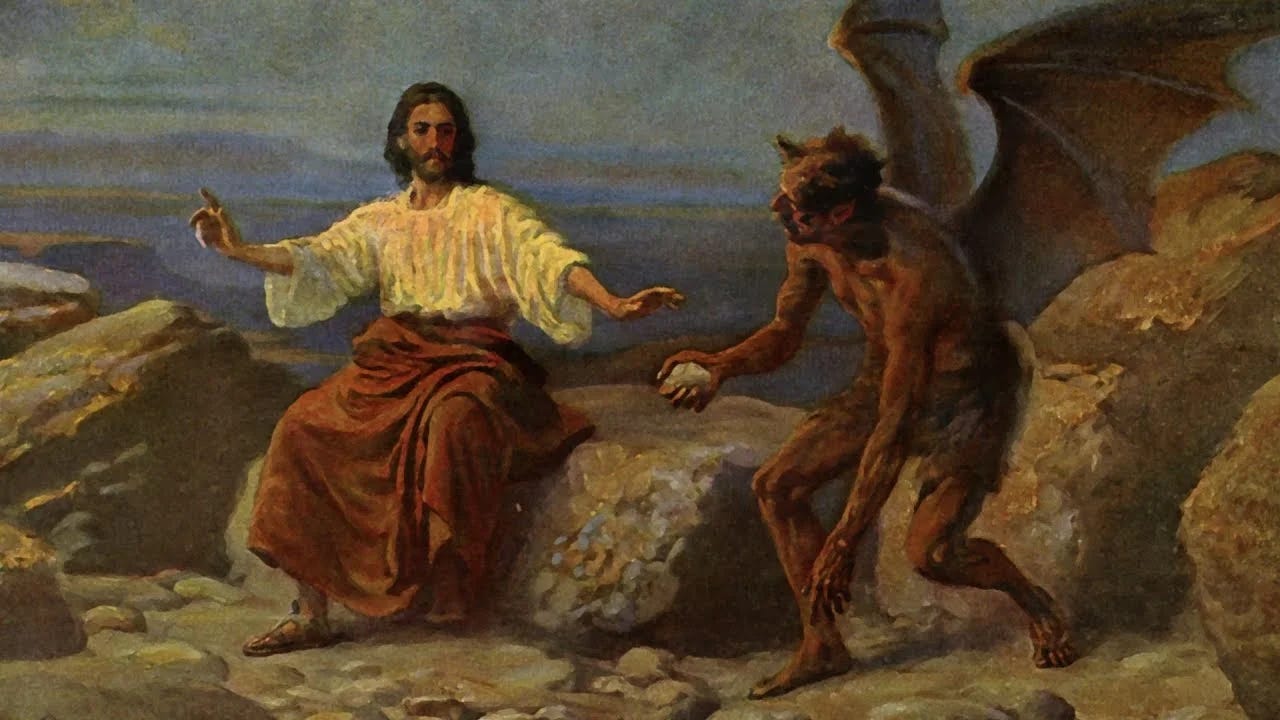
Yet one of the most astonishing scenes in all of Scripture tells a completely different story. When the devil confronted Jesus in the wilderness, he didn’t deny God’s Word. He quoted it.
That single fact overturns one of the most dangerous assumptions many Christians make. Simply hearing Bible verses is no guarantee that you’re hearing the truth. Sometimes the most convincing lies are built, not from outright falsehood, but from carefully selected pieces of the truth.
After forty days of fasting, Jesus was hungry. Satan urged Him to turn stones into bread. Jesus refused. Then the devil took Him to the pinnacle of the Temple and quoted Psalm 91:
“He shall give His angels charge over you,” and, “In their hands they shall bear you up, lest you dash your foot against a stone.” (Matthew 4:6)
Some readers might assume the devil twisted the passage beyond recognition. But he didn’t.
If you open your Bible and read Psalm 91, you’ll discover that Satan quoted it accurately. Word for word, his quotation was true.
So where was the deception?
The deception was not in what he quoted.
It was in what he was trying to make the passage mean.
Satan was urging Jesus to throw Himself from the Temple, demanding that God perform a spectacular miracle to rescue Him. In effect, he was saying, “If God has promised to protect You, prove it. Force His hand. Make Him keep His promise.”
Jesus immediately exposed the deception with another passage of Scripture:
“It is written again, ‘You shall not tempt the Lord your God.’” (Matthew 4:7)
Notice what Jesus did not say.
He did not answer, “That’s not in the Bible.”
He did not answer, “You quoted the verse incorrectly.”
Instead, He answered Scripture with Scripture. He understood that no passage can be interpreted in a way that contradicts the rest of God’s Word. One verse never cancels another. The Bible speaks with one voice, and every passage must be understood in harmony with the whole.
Even more fascinating is what Satan left unsaid.
He stopped quoting Psalm 91 at exactly the point where it became uncomfortable for him.
The very next verse declares:
“You shall tread upon the lion and the cobra, the young lion and the serpent you shall trample underfoot.” (Psalm 91:13)
The irony is impossible to miss.
The serpent quoted the Psalm, but carefully avoided the verse about the serpent being crushed.
That is often how deception works.
The most dangerous lies are not complete fabrications. They are partial truths. They tell you enough of God’s Word to sound convincing while quietly leaving out the part that would expose the error.
This pattern appears throughout Scripture.
When the Pharisees criticized Jesus for healing on the Sabbath, they could point to biblical commands about keeping the Sabbath holy. Their problem was not that they believed Scripture. Their problem was that they elevated one part of God’s revelation while ignoring the rest. They knew the letter of the Law but missed its purpose.
The same thing happened repeatedly during Christ’s earthly ministry. Religious leaders quoted Moses while rejecting the very Messiah to whom Moses pointed. They searched the Scriptures diligently, yet failed to recognize the One about whom those Scriptures testified.
The apostles encountered the same problem.
St. Peter warned that some people twisted the writings of St. Paul “to their own destruction” (2 Peter 3:16). Peter didn’t say they rejected Paul’s letters. He said they accepted them. They quoted them. They just distorted their meaning.
That danger has never disappeared.
Nearly every false teaching that has troubled the Church has appealed to the Bible.
Arians quoted Scripture.
Jehovah’s Witnesses quote Scripture.
Mormons quote Scripture.
Prosperity preachers quote Scripture.
Countless internet teachers quote Scripture.
Even atheists quote Scripture.
Finding a Bible verse has never been the difficult part.
The difficult part is understanding it correctly.
A clever debater can build an impressive case by selecting only the verses that seem to support his position while remaining completely silent about dozens of passages that point in another direction. A person can make almost any doctrine sound biblical if he is allowed to choose only the evidence that favors his conclusion.
That temptation isn’t limited to cult leaders and famous prosperity preachers.
We all have been guilty of it at one time or another.
The greedy man loves verses about God’s blessings, but quietly skips the commands to give generously.
The lazy man quotes Christ’s words, “Do not worry about tomorrow,” while ignoring the biblical command, “Go to the ant, you sluggard,” where we are called to work and prepare diligently.
The harsh and judgmental Christian quotes passages about rebuking sin, but overlooks the commands to show mercy, patience, gentleness, and love.
The coward quotes, “Judge not,” whenever someone confronts a sin, yet forgets that the same Lord also commanded His disciples to “judge with righteous judgment” (John 7:24) and to watch out for false teachers (1 John 4:1).
Whenever we cling to the verses we like, while ignoring those that challenge us, we begin handling Scripture the way Satan did. We are no longer allowing God to speak. We are using God’s Word to reinforce what we already wanted to believe.
So how do we protect ourselves?
First, we must read passages in their context. Satan quoted two verses. Jesus understood the entire revelation of God. Individual verses were never intended to stand alone like fortune-cookie slogans. They belong within chapters, books, and ultimately within the entire story of God’s saving work.
Second, we must become students of the whole Bible, not merely collectors of favorite verses. Many Christians know a few dozen passages extremely well but have never read large portions of Scripture. That leaves them vulnerable to anyone who is skilled at proof-texting.
Third, we should approach Scripture with humility. Instead of asking, “Which verses support what I already think?” we should ask, “What is God actually saying?” Those are very different questions.
Finally, we should read Scripture as Christians have always read it—not as isolated individuals inventing our own interpretations, but within the life of the Church that preserved these writings, proclaimed them, and faithfully handed them down from generation to generation.
The devil has no objection to people owning Bibles.
He has no objection to people quoting Bible verses.
He has no objection to people memorizing large portions of Scripture.
What he fears is people who understand the Scriptures correctly, who read them in their full context, who obey them wholeheartedly, and who refuse to let one isolated verse overturn the clear teaching of the whole counsel of God.
The devil quotes Scripture, because he knows that when truth is carefully trimmed and skillfully misapplied, it can become a remarkably effective weapon.
Jesus showed us a better way.
He didn’t merely know the words of Scripture.
He knew what they meant.
So true, thank you
That is awesome council.