
Wordlake
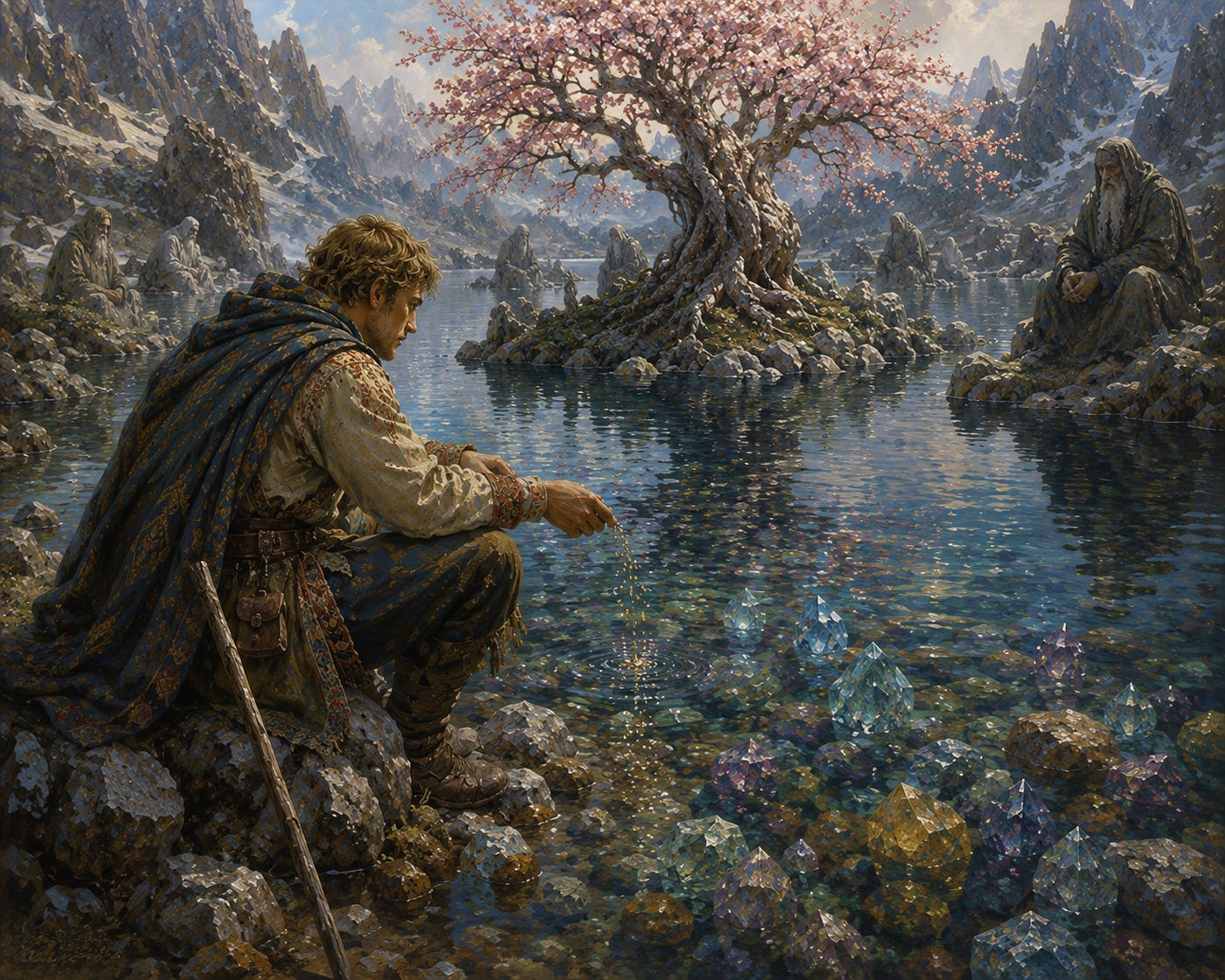
According to legend, on the high northern slope, where snow lies year-round, there is a lake full of precious stones. By feeding the fish dwelling there, one may awaken the voice of the stones...
Wordlake
Anatoly Chekunkov
Lost among the intricate tangles of mountain ranges lay the Valley of Seven Streams. Cascading torrents of water flowed into the valley from the north, west, and east, spilling into a floodplain lake, which in turn served as the source of a river that descended along the southern slope. Since time immemorial, the descendants of ancient highlanders had tilled the fields in the valley, preserving the traditions and way of life of their forebears. They were red-bearded, stocky men with mops of curly hair, alongside fair-haired women. Their singing during field work filled the valley to its very brim, much like fragrant wine fills a wedding goblet.
The princely lineage of this tribe was distinguished by piercingly blue eyes, the color of which resembled the clear sky at dawn. The prince ruled over the people, dispensing justice and caring for the health and equipment of those who guarded the borders against wild beasts and against various adventurers who occasionally wandered into these parts. In times of difficulty, the ruler convened a veche—a council—of the wisest and most talented residents of the settlement. Thus it went on century after century, until the princely line died out, and the last of the princes—Dobromir—seeing his end approaching, decided to gather the veche under a centuries-old yew tree to decide the future fate of the princely authority.
“My friends,” Dobromir began his speech, “our people have lived for centuries in prosperity, thanks to the wisdom of our ancestors and the labors of the princely line. Now you see that your prince stands already on the threshold of eternity. Who will judge with truth and wield the word after me? This we must decide together, so that there may be no unrest when my eyes close forever.”
After such words from the prince, a sad silence fell, and fourteen wise men sank into deep thought. Twice, night gave way to day, and five pitchers of dogwood lemonade were consumed. At last, the eldest of the wise men spoke:
“According to one legend, high on the northern slope, where snow lies year-round, there is a small lake—a little lake—that never freezes and is full of precious stones. Each of them speaks a word when touched by a fish’s fin. My grandfather told me that wise men from our settlement set out for that lake more than once, but only one man ever returned. He warned us that there is no need to visit that place out of idle curiosity. Then he added that if the wise men gathered at a veche and could not reach a unanimous decision, the lake would show them the path they must follow. Only let the one who sets out take the finest grain to feed the fish dwelling there, and thereby awaken the voice of the stones.”
The prince understood that this fateful moment had arrived. Without long deliberation, they equipped the youngest of the wise men—Kholmogor—for the journey, believing that he would more easily overcome the difficult path high into the mountains.
Dobromir gave him this parting counsel:
“The council of the wisest sends you to Wordlake. The entire settlement will await you. Do not tarry on the road if you find the answer.”
Kholmogor prepared for the distant journey. He took an iron staff from the blacksmith and the finest grain from the ploughman. The women of the settlement baked flatcakes for his travel. The traveler set out while the mist still touched the rooftops and the birds were only just preparing to fill the valley with their chirping.
The day was already waning toward night when Kholmogor reached the edge of the snow cover, and not crossing it, spent the night under a centuries-old spruce, wrapped in his cloak and spruce boughs. The entire next day he spent climbing up a glacier, digging his iron staff into the crust and ascending toward the very clouds. Around him lay a white, lifeless desert and the gray spurs of cliffs. The wise man began to wonder about a place to sleep, when suddenly he felt a faint touch of warm air. Moving in the direction of this breath, he climbed over huge boulders and stopped, utterly enchanted by the sight that opened before him. In the center of a small lake grew a tree; its pink blossoms emitted a fragrance unmatched anywhere on earth.
The water was so clear that all the submerged crystals could be seen. Their abundance and the play of reflections so captivated one’s gaze that one could have stood there in awe for centuries. But Kholmogor carried in his heart the hopes of the entire people, and that helped him shake off the spell and look around. Nearby on the stones sat hunched figures, as if covered in hoarfrost. Looking more closely, Kholmogor recognized one of them as Mim—a wise man he had seen in his youth, who many years earlier had not returned to the settlement. A chill ran down the wise man’s spine. He understood that the same fate might await him if he lost his vigilance.
Sitting down on a free boulder, Kholmogor pressed his iron staff against his big toe, so that the pain would keep him clear-headed. While refreshing himself with a flatcake, he gazed intently at the roots of the tree and the crystals lying among them. By a barely perceptible gleam reflecting from scales, Kholmogor made out several small fish that barely moved their fins, holding themselves in stationary position. The wise man took out the grain he had prepared, and threw it into the water. Ripples passed over the surface, and the fish began to stir. At that very instant, like a crystalline chime, a sound swept over the surface of Wordlake—the crystals, awakened by the fins of the fish, had begun to speak.
Kholmogor was at first taken aback by such a tinkling cacophony, but seconds later his ear could make out phrases: “Greetings, bold wanderer! Greetings, fortunate son of your people!” He threw in more grain—”The common good of your people...” “A merciful ruler for your people...” Who then was this future ruler? The wise man poured out the remains from his pouch, and the stones sang out the final phrase: “Enter the settlement—the first shelter you enter shall be the royal chambers.”
Kholmogor rose resolutely and strode back without looking around, and then began running, until he reached the centuries-old spruce and collapsed from exhaustion into the embrace of the spruce boughs. The young wise man slept for a full twenty-four hours, and after waking and refreshing himself, hurried back to his native settlement.
He understood what the enchanted Wordlake had meant. On a ridge, finding a tree that had been struck by lightning, Kholmogor smeared himself with soot, tied his beard in a knot, tore his clothes, and wrapped himself in a kerchief like a wandering dervish. Then he cupped water in his hands, and seeing his reflection in it, thought with satisfaction that now his fellow villagers would not recognize him.
When dusk was already falling, he entered his native settlement, and walking along the main street, began in a hoarse voice to beg for alms and shelter. Many brought him flatcakes and water. Someone gave him a coin and a new bag. Yet no one was eager to take the wanderer in for the night.
At last, he came to the house of a widow whose son was chopping wood. The widow sent her young son to fetch a flatcake for the wanderer. The son, hearing that the man had nowhere to sleep, began to beg his mother: “Let us make a bed for the traveler in Father’s study; that’s how he would have wanted it.” The woman secretly wiped away a tear, for her husband had been a man of great heart, and her son Milodar had grown up quite worthy of his father. They invited the wanderer into the house, heated the bathhouse, and prepared a modest supper. Imagine their surprise when the well-known wise man of the settlement emerged from the bathhouse!
“Kholmogor, what have you done with our wanderer?” the woman exclaimed indignantly. The wise man laughed, embraced her and her son, and said:
“This is how one returns from the snowy peaks and the enchanted lake.”
The next day, Prince Dobromir summoned the widow’s son to him and began teaching him the princely craft. A year later, the new prince Milodar took as his wife the girl with the sweetest voice in the village. They soon had a multitude of children, all of whom were born wondrously bright-eyed, further convincing the people that the blessing of good instruction and governance had passed to the new princely line.
Here is the story in the original Russian:
It is so Beautiful.
Thank you so much Father for this wonderful lesson in this wonderful tale.